1
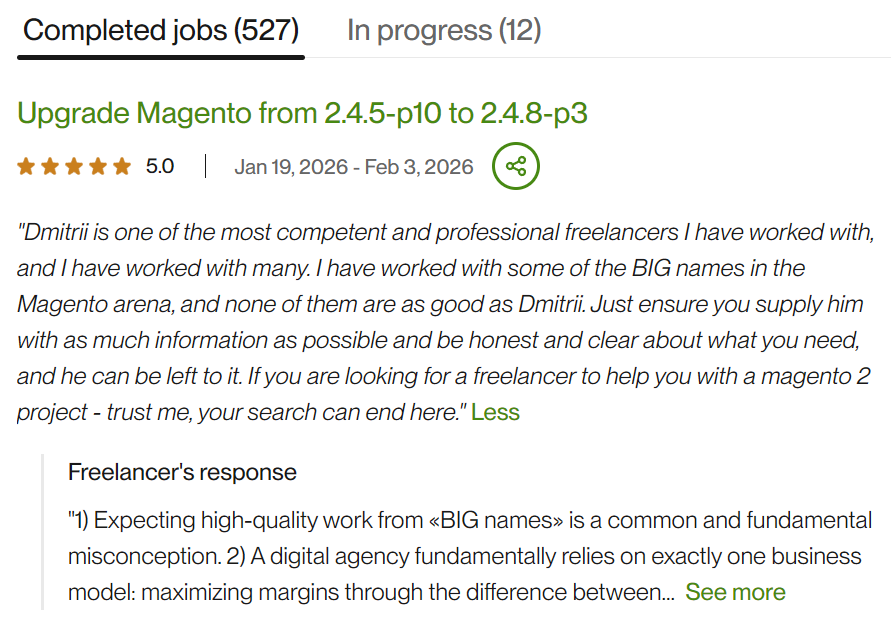
Expecting high-quality work from «BIG names» is a common and fundamental misconception.
2. Agency business model / Rate arbitrage / Transaction costs of agencies
A digital agency fundamentally relies on exactly one business model: maximizing margins through the difference between the rate billed to you and the real worker's cost.
An agency is economically unable to pay real workers more than 20-30% of your billing rate due to its own huge operational costs.
So, an agency economically cannot afford to hire experts.
The primary (but non-obvious to outsiders) reason for this 70–80% margin is massive marketing expenses: client acquisition costs an agency $10³-10⁴ in 2026.
The secondary (obvious) reason is the organizational overhead of being a middleman, including management salaries, taxes, software licenses, and office maintenance.
3. Examples
- If you pay an agency $70/hr — your work always goes to India, as the agency is forced to hire a worker at $14–21/hr.
- If you pay $50/hr, your work likely goes to Bangladesh ($10–15/hr).
4. «Experts» as a marketing showcase of agencies
A «senior» at a «BIG name» might communicate with you, but will never perform the work: otherwise, the cost of his labor will bankrupt the agency.
The experts displayed on an agency's website serve solely as a marketing showcase (presale tool) and never perform your work.
If a claimed «expert» is actually performing your project, the agency is deceiving you regarding his true level of expertise.
Once again: an agency fundamentally cannot afford real expert labor due to the limitations of its business model.
5. The Magento market failure
The Magento services market in 2026 demonstrates a classic market failure, driven by fundamental information asymmetry between key sellers (agencies) and buyers (clients).
At the presale stage, the agency knows the actual low quality of its workforce, while the client remains unaware of it.
Consequently, the client is forced to rely on deceptive indirect signals like a «BIG» brand, which acts as a red herring, distracting the client's attention from the critical question of who exactly will write the code.
Agencies exploit this information asymmetry by investing heavily in sales and in creating external signals of quality (brand, office).
This occurs not because agencies are «bad»: agencies simply cannot afford real workers above the junior level.
Their only economic option is selling low-cost labor at premium prices behind a corporate facade.
6. Adverse selection → The market for lemons
Consequently, the Magento services market is driven by adverse selection.
Agencies (delivering low-quality services but possessing effective marketing) outcompete experts already at the presale stage, as the quality signals of real experts (e.g. GitHub commits or in-depth technical articles) are incomprehensible to potential clients.
This has turned the Magento market into a market for lemons.
Real experts cannot compete with agencies' professional sales managers in justifying rates.
Since experts become invisible to clients and lose to agencies (who hire juniors), experts leave the market for sectors where their expertise is valued more.
7. Gresham's law
The phenomenon mirrors Gresham's Law: «bad money drives out good».
Digital agencies massively release «debased currency» by selling poor services disguised as premium «BIG name» expertise.
A client is unable to verify the «gold content» (the real expertise in Magento) before signing the contract and is forced to trust the «minting» (the brand).
The mentioned information asymmetry creates a single nominal exchange rate, where the agency's marketing promises are equated to the expert's real skills.
It causes «bad money» (cheap junior labor) to drive out «good money» (real Magento experts).
8. The outcome
The outcome is a Tragedy of the Commons scenario.
Agencies predatorily exploit the finite resource of client trust by providing low-quality services to serve their short-term interests.
Their rational strategy maximizes individual profit by selling the low-skilled labor of juniors at expert rates.
After depleting client trust in technology X, agencies simply switch to technology Y (e.g., to Shopify).
Their switching costs are negligible, since they never do the work themselves, and they simply hire new juniors specializing in technology Y instead of X.
Real experts do not behave in such a destructive way, because for them Magento is a very long-term investment (I have personally invested in it full-time for 16 years).